
 SEARCH
Our mission in the San Leandro Unified School District is to educate students to achieve academic excellence while becoming confident, collaborative, and engaged citizens in a community rich in heritage and diverse in culture.
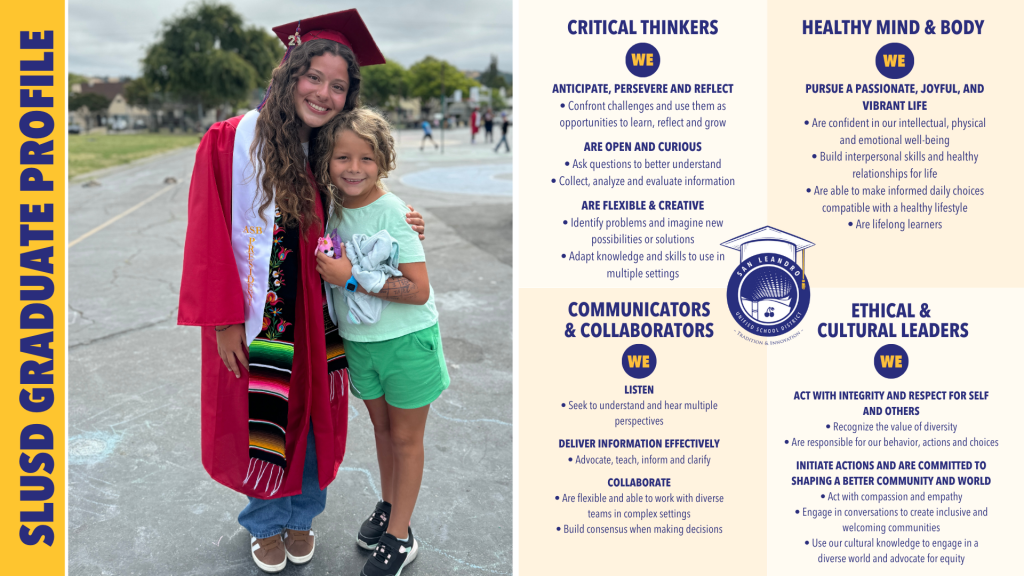
Our San Leandro Unified School District Graduate Profile is a community-developed vision that outlines the essential skills, competencies, and mindsets students should embody upon graduation.
Our Strategic Approach
Our goals bring organizational focus to our district. The actions under each goal describe concrete steps for staff to implement the plan over the next three years. Staff also create metrics and work plans to ensure implementation, progress monitoring, and evaluation.
GOAL #1: Deep Learning for Real-World Readiness
Expectation: We deliver rigorous, equitable, and responsive instruction that builds literacy, math, and real-world skills to equip every student for lifelong success in college, career, and community.
- Ensure universal implementation of the SLUSD Board-adopted Core/Supplemental Curriculum and standards with multiple assessments like diagnostic, progress monitoring, and performance-based tasks so students receive timely, meaningful instruction and feedback to support their learning.
- Expand evidence-based instructional strategies in all classrooms to help all students, including English learners and students with disabilities, learn and succeed. This includes strengthening the use of Universal Design for Learning (UDL), culturally and linguistically sustaining teaching practices, English Language Development (ELD) and strategic technology integration.
- Apply research-based literacy strategies to improve outcomes for all students using shared milestones for progress in elementary, middle, and high school. In TK-5th grade, structure daily phonological lessons and small group reading instruction to build oral fluency, vocabulary, and comprehension. In grades 6-12, build academic vocabulary, support structured discussions, and assign frequent reading and writing tasks that develop analysis and argumentation skills. For all grades, adjust instruction to support English learners, students with disabilities, and Dual Language Immersion students, and include coursework that promotes communication, critical thinking, and the development of media literacy skills.
- Leverage research-based strategies to deliver high-impact math instruction. These strategies will promote meaningful mathematical discourse, strengthen problem-solving skills, and engage students in rigorous performance tasks demonstrating conceptual understanding and real-world application.
- Routinely progress monitor and analyze student math performance results and engagement to inform differentiated instruction and small group intervention during core instruction that addresses specific skills gaps and attends to common pitfalls and pathways students experience.
- Provide ongoing support to middle and high school students and families to understand high school pathway options and identify courses required for admission to CSU and UC schools, as well as graduation requirements. This includes improving college readiness recovery programs for high school students to retake and successfully complete courses required for CSU and UC admission, to stay on track for graduation with postsecondary options.
- Identify and actively recruit students for dual enrollment courses and Career Technical Education (CTE) pathway programs that include a variety of apprenticeships and work-based learning.
Goal #2- Prioritize Student Health and Belonging
Expectation: We sustain safe, supportive environments that promote health, nurture belonging, and use restorative practices so every student can thrive in learning.
- Implement systems to assess, monitor, and adapt behavioral health services based on student needs to improve learning outcomes.
- Strengthen and expand community partnerships to increase access to comprehensive student support services and improve collaboration with partners committed to advancing outcomes for the broader community.
- Develop and maintain a district-wide sustainability plan to ensure dedicated wellness services at every school.
- Deliver universal education on healthy relationships to foster a positive, connected school community and increase student engagement in learning, leading to measurable improvements in attendance, behavior, and academic performance.
- Establish inclusive, school-based behavior teams with diverse representation to collaboratively design and implement positive behavior support systems aligned with restorative practices, ensuring they reflect the needs and voices of the entire school community.
- Build and sustain student peer leadership teams that promote empathy, care, and an inclusive school culture through mentoring and collaboration, leading to increased student belonging, reduced conflict, and the development of leadership skills.
- Ensure students feel physically and emotionally safe on campus so they can focus on learning without disruptions.
- Use restorative practices as the foundation for student discipline and behavior support, and ensure they are consistently implemented across the school.
- Support students in developing healthy digital habits and identities by educating staff and families.
Goal #3- Strong, Connected Partnerships
Expectation: We build authentic partnerships with families, staff, and the community that foster trust, honor diversity, and support student thriving.
- Guide families through significant school transitions with clarity and care by providing timely information, personalized support, and multilingual resources that address academic, social, and emotional needs.
- Empower families with the knowledge and resources to support student well-being and academic success by offering parent leadership workshops, health and wellness resources, and opportunities to partner with school staff in promoting healthy minds and bodies.
- Ensure families have access to meaningful information about their child’s progress and the support they need to take action by providing regular updates, clear communication tools, family-friendly data reports, and opportunities to collaborate with teachers and support staff.
- Promote the employment and retention of a diverse staff that reflects the student demographics of the community.
- Develop the skills and certifications for all employees through individualized support to create pathways for professional advancement within the organization.
- Develop systems and support for employee well-being and career longevity.
- Ensure all families can communicate in their home language to build trust, mutual respect, and shared responsibility for student success by providing translation and interpretation services, using culturally responsive communication tools, and training staff to engage effectively with multilingual families.
- Strengthen staff ability to recognize and respond to the cultural and linguistic strengths of families through ongoing professional learning and reflective practice.
- Establish responsive feedback loops that strengthen conflict resolution, build trust, and drive continuous improvement.
- Strengthen collaboration and communication with community-based organizations to support student learning, employee development, and districtwide initiatives.
Goal #4- Improved Infrastructure for Safety and Environmental Equity
Expectation: We advance sustainable and innovative facilities that enhance safety, promote environmental equity, and provide engaging spaces for learning and growth.
- Continue expanding our solar infrastructure to support long-term sustainability goals.
- Implement environmental controls to enhance equipment efficiency, reduce operational costs, and minimize our carbon footprint.
- Develop workforce housing plans with attention to energy efficiency.
- Implement audio enhancement devices, in-class monitors, and sound systems in every classroom to support students’ universal access to daily teaching.
- Ensure district and school site collaboration to build systems for responding to site needs in a timely fashion to maintain clean and safe conditions for students and staff.
- Train and support staff on the latest technology, methods, and safety measures to ensure safe, clean, and efficiently maintained facilities.
OUR IMPLEMENTATION TIMELINE AND APPROACH
As we enter this new strategic cycle, our work continues the steady progress our community has built together over the past decade-plus—expanding transitional kindergarten, launching dual language immersion programs, increasing technology access, and improving our school facilities. This next phase strengthens that foundation while preparing us for what lies ahead:
Year 1 (2025–2026): San Leandro Unified School District (SLUSD) will assess our readiness in each goal area. Building on established systems and practices, we will identify the strategies and supports needed to ensure strong, sustainable implementation.
Year 2 (2026–2027): With this foundation in place, SLUSD will fully implement key initiatives. We will monitor progress carefully, reinforcing successful practices and addressing challenges so that students, families, and staff experience meaningful and lasting impact.
Year 3 (2027–2028): SLUSD will evaluate the results of implementation, making adjustments to keep goals and initiatives aligned with the aspirations of our community. This cycle of reflection and refinement will guide the district into the next chapter of strategic action.
OUR PROCESS
Phase One: Review and Goal Development
The process began in fall 2024 when the superintendent and senior cabinet members reviewed the 2021–2024 Strategic Plan to determine next steps. This review was guided by the district’s Local Control Accountability Plan (LCAP) and each school’s Single Plan for Student Achievement (SPSA). Input was also gathered through school site LCAP engagement meetings, comments from the District English Learner Advisory Committee (DELAC), and feedback from the LCAP Parent Advisory Committee, which helped identify priorities for implementing the current plan. Following this input, district leaders worked within their divisions to develop new goals aligned with the district’s current trajectory of work. These draft goals were presented to the Board of Education during a Special Strategic Plan Work Session on May 21, 2025.
Phase Two: Trustee Review and Community Engagement
Over the summer, Board of Education trustees engaged in a series of review and refinement sessions to strengthen the draft plan. Trustees received updates and provided input, while an additional Board of Education engagement meeting on August 13, 2025 created another opportunity for community feedback and trustee discussion.
Phase Three: Final Refinement and Adoption
District staff incorporated trustee and community feedback into the final draft of the plan. The revised version was presented for adoption, and the Board of Education formally approved the new strategic plan on September 9, 2025.